
 Jayakumar B
 Hyderabad – As part of the ongoing university industry collaboration formalised under the Memorandum of Understanding signed on 18 November 2025, the leadership team of Emertxe Information Technologies Pvt. Ltd. recently visited the Jawaharlal Nehru Technological University Hyderabad (JNTUH) campus for a mid-program review and to chart the path forward. Mr. Jayakumar Balasubramanian, Director, Emertxe, and Mr. Mubeen Jukaku, Technology Head, Emertxe, met with the JNTUH leadership and reviewed the progress of students currently enrolled in the joint deep-tech skilling program.
The visit, hosted at the University Industry Interaction Cell (UIIC), brought together Dr. T. Kishen Kumar Reddy, Vice Chancellor, JNTUH; Dr. K. Venkateswara Rao, Registrar, JNTUH; and Dr. Anitha Sheela Kancharla, Director, UIIC, JNTUH, for a structured review of student learning outcomes, demonstrations of project work, and discussions on the next phase of the program.
A Strong Foundation: Embedded Systems Training from C/C++ to Embedded Linux and STM32
The mid-program review highlighted the structured progression that students have undertaken since the program commenced. The cohort began with C and C++ programming and Data Structures – the foundational programming base on which any domain-specific technology stack must be built. With this foundation in place, students moved on to Embedded Linux for operating system fundamentals, followed by micro-controller programming on the widely used STM32 platform.
This carefully sequenced curriculum mirrors the way deep-tech engineering teams build real products in industry – first establishing software engineering rigour, then layering operating system understanding, and finally moving into hardware-software integration on industry-standard microcontrollers. The review reflected positively on the way students have adapted to this practical pedagogy, with strong attendance, discipline, and engagement reported across the cohort.
Engineering Student Projects - A Thousand Lines of Code and End-to-End Discipline
A central theme of the mid-program review was the importance of project work in shaping industry-ready engineers. On average, every student in the program writes approximately 1,000 lines of source code as part of each module project.
More importantly, these engineering student projects expose students to the complete software engineering lifecycle – understanding the requirement, converting it into high-level and low-level design, proceeding through coding, and finally validating the work through structured testing. This end-to-end project execution discipline is what separates a programmer from an engineer.
Building a Digital Career Portfolio Through Embedded Systems Training
To make these outcomes visible and verifiable to recruiters, students are guided to build a Digital Career Portfolio – comprising a strong LinkedIn profile, an active GitHub repository of project code, and a well-enriched resume that captures the full embedded skill set and project list developed during the course. In a recruitment landscape where deep-tech companies look beyond marks and certificates, this portfolio approach gives students a credible, demonstrable proof of skill.
Vice Chancellor Inspects Student Projects - University Industry Collaboration in Action
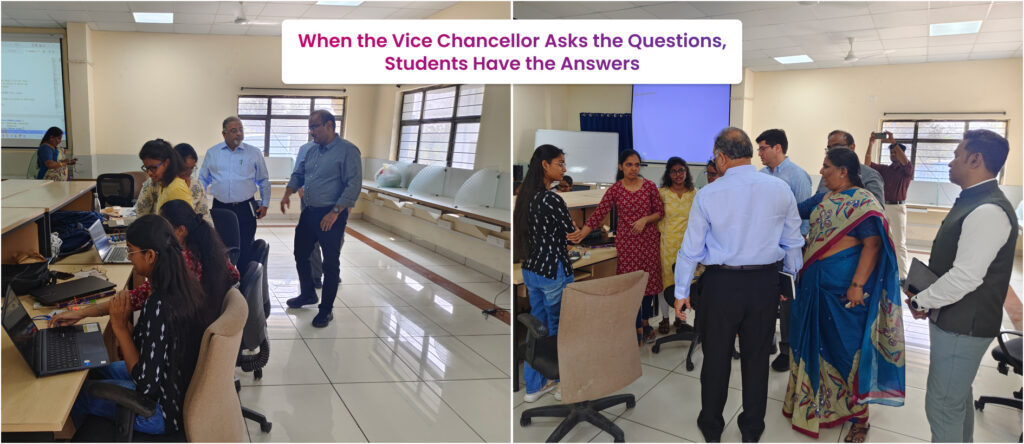
A particular highlight of the visit was the active interest shown by the Vice Chancellor in the students’ progress. Dr. T. Kishen Kumar Reddy was invited into the UIIC building, where he personally took demonstrations of the projects students have built – primarily centred on the STM32 microcontroller platform.
Walking through the project showcases, the Vice Chancellor engaged directly with students on the technical decisions they had made, the challenges they had overcome, and the design approach they had adopted.
Following the demonstrations, the Vice Chancellor distributed Spot Awards to top-performing students. Recognising and rewarding excellence is a long-standing part of the Emertxe culture. The on-the-spot recognition by the Vice Chancellor added significant institutional weight to that culture and visibly boosted student morale.
The exercise also reinforced one of the program’s core principles – learning by doing. When students are able to showcase a working project to senior officials such as the Vice Chancellor, the learning outcome itself becomes the proof that the technology has been mastered. The confidence that students gained from demonstrating their work first-hand is, in many ways, as valuable as the technical knowledge they have acquired.
JNTUH Leadership Gains a First-Hand View - Industry Academia Collaboration at Work
For the JNTUH leadership team – the Vice Chancellor, the Registrar, and the Director of UIIC – the visit offered a real, hands-on perspective on what the students have actually been building. By walking through project outcomes and engaging with the students directly, the leadership team gained a clear view of the skill set that students have acquired and the structured approach they have adopted.
The review concluded with both sides expressing satisfaction with the way the program has been progressing. As students continue to add more projects and build out their digital career portfolios, the program is expected to open significant career pathways with deep-tech companies operating across automotive, robotics, consumer electronics, electric vehicles, telecommunications and networking, and other allied domains.
70:30 Practical-to-Theory Ratio - The Learning-by-Doing Philosophy Behind the Embedded Systems Training
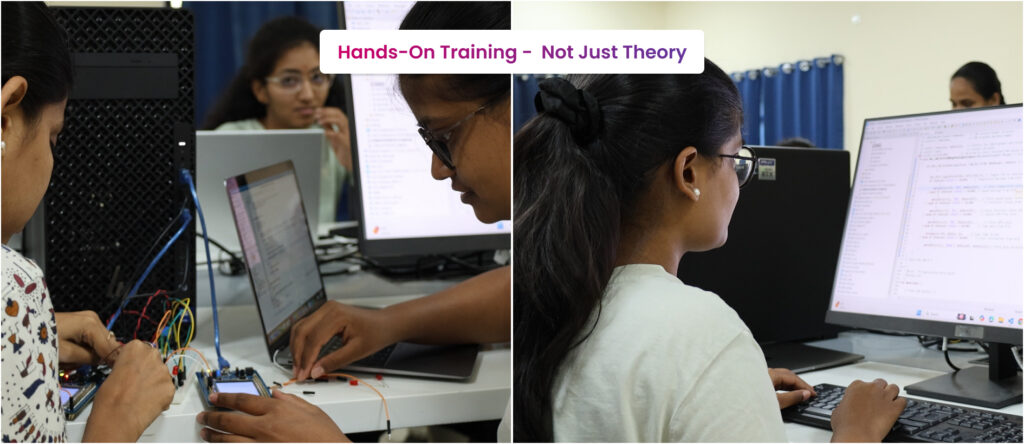
The progress observed during the mid-program review is a direct reflection of Emertxe’s long-standing learning-by-doing philosophy. The program maintains a 70 percent practical to 30 percent theory ratio, ensuring that students walk away with maximum takeaway – not only in foundational theoretical aspects, but more importantly in the application of technology to solve real engineering problems. This applied focus is precisely what makes graduates of the program employable in deep-tech industry roles.
In an industry where companies increasingly look for engineers who can contribute from day one, each project completed, each line of code written, and each design decision made adds to a student’s readiness for the workplace.
The Road Ahead
With the mid-program checkpoint successfully completed, the focus now shifts to advanced modules, deeper project work, and intensified placement readiness. Both Emertxe and JNTUH have reaffirmed their commitment to ensuring that every student who completes the program is industry-ready and well-positioned to step into the deep-tech engineering workforce.
The visit also explored potential pathways forward under the broader scope of the MoU, including expansion of the program, deeper faculty engagement, and the proposed Center of Excellence.
As the JNTUH–Emertxe industry academia collaboration continues to evolve, the mid-program review stands as clear evidence that the partnership is delivering on its core promise – turning engineering students into confident, capable, and demonstrably skilled deep-tech professionals. For anyone following technical education news in India’s embedded systems and deep-tech space, this is a story worth watching.
| Serial No. | Related News | Links |
|---|---|---|
| 1. | Emertxe at Bengaluru Tech Summit 2025: Showcasing India’s Future in Embedded Systems & IoT | Click Here |
| 2. | Emertxe and JNTU Hyderabad Partner to Power Deep-Tech Skilling and Women Empowerment | Click Here |
| 3. | Why Upskilling in Embedded Systems is a Smart Career Move for Working Professionals | Click Here |